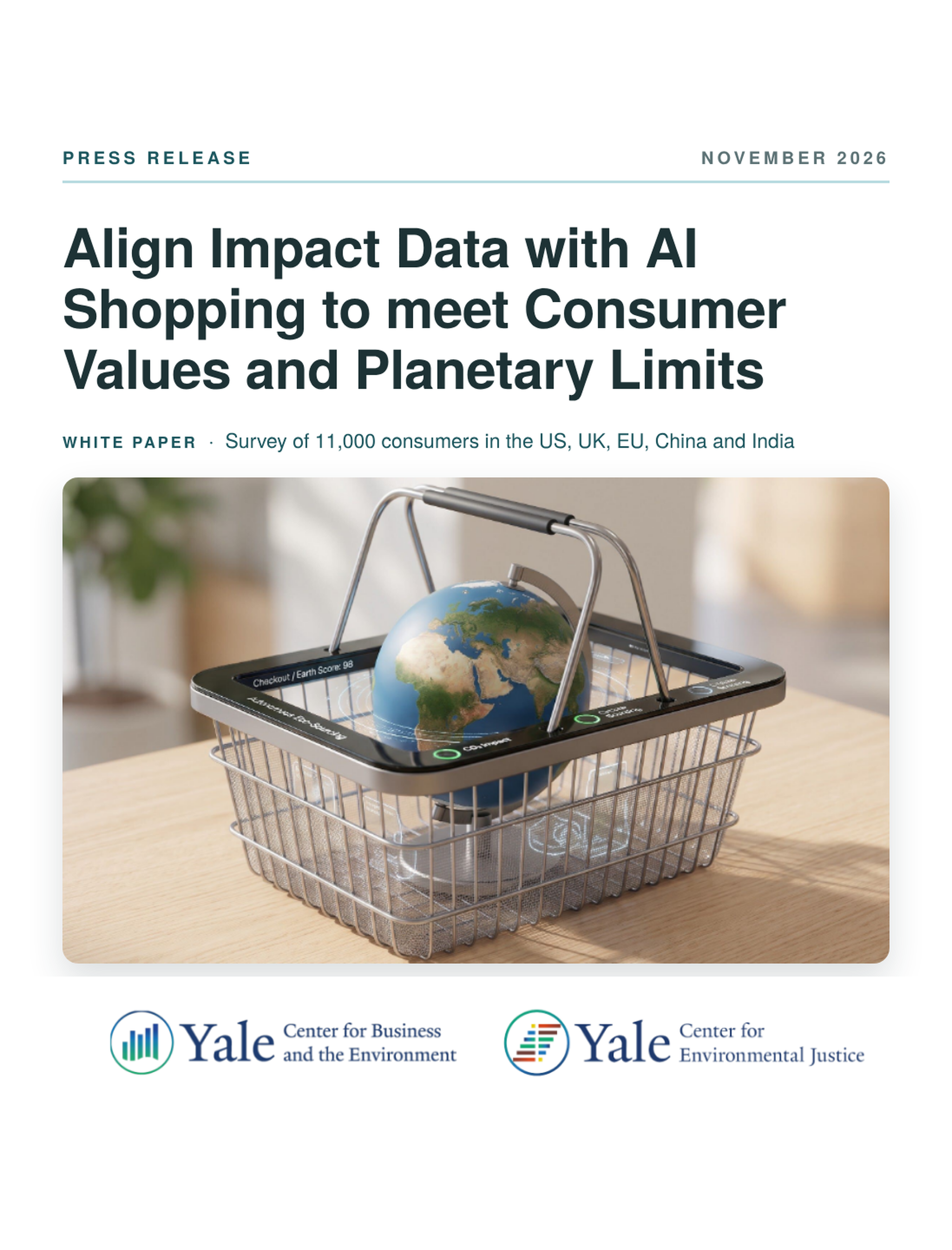
Align Impact Data with AI Shopping to meet Consumer Values and Planetary Limits
Stockholm, London, and New York - 12 November 2026 - With AI agents projected to orchestrate $3 trillion to $5 trillion in global consumer goods sales by 2030, the question is what those agents will optimize for. A new survey of 11,000 consumers across the US, UK, EU, China and India shows that consumers weigh health, budget, and environmental impact together, and that they trust banks and payment providers most to deliver impact information.
Stockholm, London, and New York - 12 November 2026 - The Yale Center for Business and the Environment and the Yale Center for Environmental Justice, in collaboration with Doconomy and Exponential Roadmap Initiative, today announced the release of their joint white paper: “Banking on Agentic Commerce: A narrow window for consumer intent and impact data to future-proof just and sustainable commerce.”
Backed by a unique consumer survey gathering input from 11,000 respondents across the US, UK, EU, China and India, the white paper outlines a critical, time-sensitive opportunity. As e-commerce rapidly transitions toward autonomous AI agents capable of evaluating, selecting, and executing purchases on behalf of consumers, the authors urge the industry to establish open, standardized social and environmental impact data protocols before closed commercial algorithms default strictly to price, speed, and margin.
41%: Consumers who would set avoiding harmful ingredients as a filter for an AI shopping assistant, the most chosen filter overall, ahead of budget (30%), packaging and waste (27%) and carbon footprint (26%).
53–58%: Net trust in banks and payment providers to deliver honest, accurate impact data in Western markets, the highest of any source (77% in Asia). AI assistants reach 27–35% in Western markets.
61%: Consumers who find impact information in their banking app useful (84% in Asia). In Western markets, however, the banking app ranks fourth to sixth of six channels, behind on-pack information.
Agentic Commerce - facilitated consumption as a race to the bottom or a narrow window for positive impact?
As digital commerce shifts upstream to an autonomous "decision layer", autonomous AI agents threaten to exacerbate unsustainable consumption patterns unless provided with standardized, values-aligned transaction metadata. The paper warns that without a comparable, consistent standard for sustainability, justice and other key impact variables, shopping agents are likely to optimize for price, speed and conversion, leaving out much of what consumers say they weigh.
Key findings from the empirical research include:
The "Say/Do" Gap and Point-of-Sale Friction: Reported barriers point to friction at the point of sale, not only a lack of intent. 36% cite sustainable options as too expensive, 28% say research takes too much time, 27% find brand sustainability information confusing, and 22% distrust brand claims. The survey captures stated preferences rather than purchases, but the findings are consistent with friction contributing to the gap between what people value and what they buy. Reduced friction has the potential to reduce the gap and to help consumers align their purchasing with their intentions.
Multi-Dimensional Consumer Intent: When defining rules for AI shopping assistants, consumers favor holistic view. Avoiding harmful ingredients is the most chosen filter (41%), followed by budget (30%), packaging and waste (27%) and carbon footprint (26%).
The Institutional Trust Bridge: Banks and payment providers are the most trusted party to deliver honest, accurate impact information in every Western market (53–58% net trust) and level with government in Asia (77%). Online marketplaces (30–37%) and AI assistants (27–35%) trail in Western markets, though both score above 60% in Asia. Trust and channel don’t yet coincide: 61% find impact information in banking apps useful, but in Western markets the banking app ranks fourth to sixth of six channels, and only 16–24% of Western respondents chose automated checkout advice.
Building the "Internet Protocol for Impact"
The white paper invites financial institutions, payment networks, the companies building agents, academic bodies, consumer advocates and standards organizations to explore together how a shared Internet Protocol for Impact could be established. The authors describe it as a small set of open rules rather than a platform: a machine-readable format for product and company impact data, agent identification at checkout, a common published method against which data can be verified, and preference profiles the consumer controls.
Dr. Michel Gelobter, Executive Director of the Yale Center for Environmental Justice: "The risk that autonomous agents could compound the negative impacts of consumer behavior is high. This whitepaper establishes a vital framework for empowering consumers and making agentic commerce instead a force for justice and sustainability.”
Mathias Wikström, CEO of Doconomy: "As agentic commerce takes shape, the critical question is what the AI agent optimizes for. Left to current default settings, AI assistants will prioritize price and speed. Our research shows consumers want more, to balance budget, health, and planetary impact, placing their highest trust in financial institutions. By establishing an open impact protocol today, financial networks can carry sustainability intent directly to the point of purchase, ensuring that agents enable mindful consumption."
Owen Gaffney, Exponential Roadmap Initiative: "The shift to agentic AI is a huge opportunity to help consumers purchase more sustainable products. The research shows people often don’t have time to research complex and confusing claims about green products. AI is a powerful tool to cut through the complexity for Earth-aligned consumption."
Acknowledgements & Survey Methodology
Representatives from Consumers International, Swedbank, Mastercard, S&P Global and Bank of Åland contributed to the white paper with their expertise and knowledge across the system it describes: consumer advocacy, payments, banking, financial data, and retail. The survey was fielded by Opinium between 26 August and 7 September 2026 among 11,000 adults using online panels: 2,000 each in the US, the UK and Asia (1,000 each in China and India), and 5,000 across 24 EU member states. Online panels in China and India skew toward urban, higher-income and digitally active respondents. The full method is set out in Appendix 7.0 of the paper.
Co-author’s Organizations
Yale Center for Environmental Justice: The Yale Center for Environmental Justice (YCEJ) works with partners across Yale and in communities around the world as a generative hub of solutions for some of the world’s most pressing environmental problems, including the climate crisis.
Yale Center for Business and the Environment: The Yale Center for Business and the Environment (CBEY) is a hub for creating innovative and sustainable solutions to the challenges facing the human and natural systems upon which we all rely. By connecting people, ideas, and resources to foster business and cross-sector solutions, CBEY works to inspire, support, and accelerate the transition to a just and thriving world.
Doconomy: Founded in Sweden in 2018 by Mathias Wikström and Johan Pihl, Doconomy is a world-leading climate financial technology provider equipping financial institutions and retail platforms with applied environmental impact tools (such as the Åland Index) to calculate, visualize, and reduce consumer carbon and water footprints.
Exponential Roadmap Initiative: The Exponential Roadmap Initiative brings together innovators, disruptors and transformers to help companies halve emissions and scale climate and nature solutions through practical frameworks, tools and guidance for business transformation towards an earth-aligned economy.